
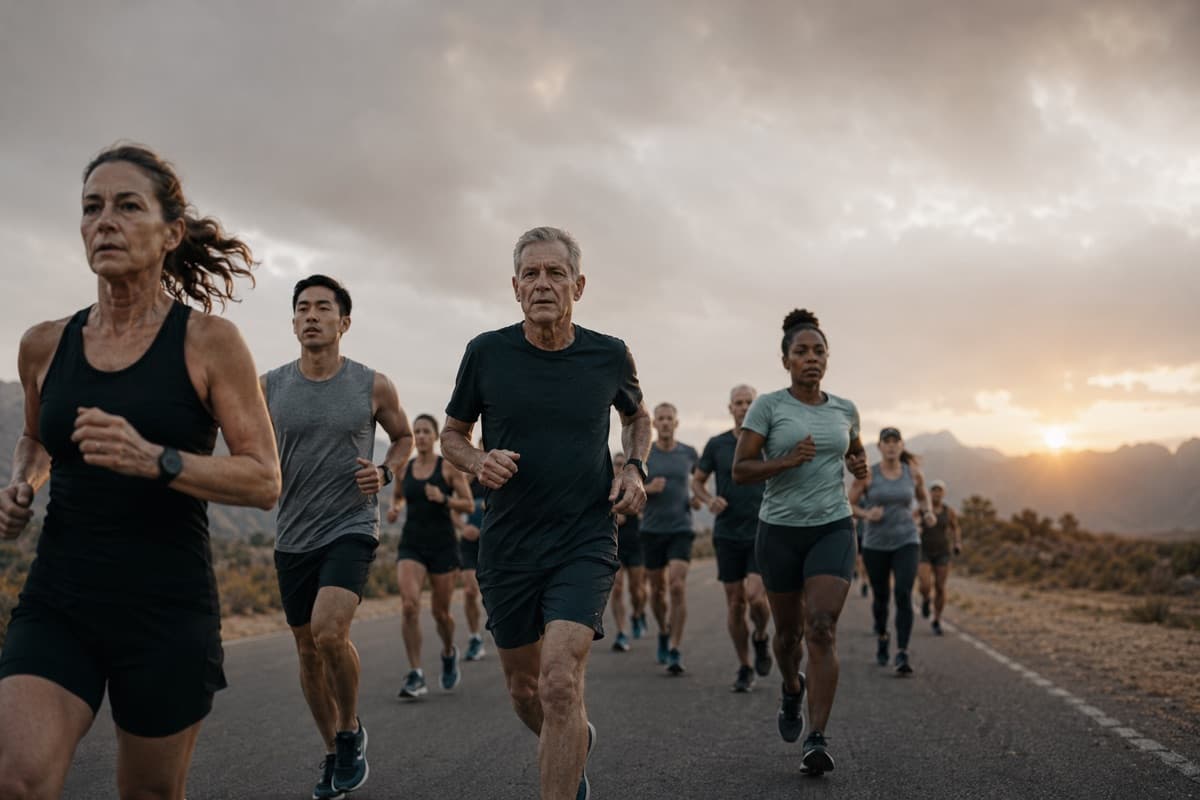
In a 2026 study, researchers graded 1,009,839 New York City Marathon finishes from 1999 to 2024, the largest masters dataset ever assembled (Athletes' origin trends in the New York City Marathon, 1999–2024, 2026). They wanted to know who runs fastest at every age. In the 20–39 groups the answer surprised no one. The fastest times belonged, overwhelmingly, to Kenyans and Ethiopians.
The 50+ groups told a different story. There the fastest masters runners came from the United States, Japan, Germany, and Switzerland. Same race, same distance, same finish line. The geography of elite performance had shifted entirely.
That one finding says something about running now. The sport's centre of gravity has moved. Not only toward older runners, though it has, but toward a picture where the country, distance and culture a runner grew up in matters more than most people admit. This is a tour of that picture, written for the runners who make it up. Late thirties, forties, and well beyond.
Why are masters runners taking over the roads?
Masters runners, 40 and older, made up roughly half of major US marathon fields as of 2019, a share that has continued growing since, and the average road finisher was 39, up from 35 in 1986 (RunRepeat, The State of Running 2019). In a Swiss study of more than 508,000 marathon and half marathon finishers between 1999 and 2014, the single biggest group at both distances, for both sexes, was 40–44 (Knechtle et al., 2016).
So the field is older. It is also slower on paper, and the two facts get confused all the time. Average marathon finish time has drifted from 3:52 in 1986 to 4:32 today (RunRepeat, The State of Running 2019). That is not masters runners losing fitness. It is the sport opening up. More first-timers, more charity entries, more people for whom finishing is the goal.
Performance among trained masters has held up well. In a 2022 review of aging masters endurance athletes, maintained training volume held the VO₂max decline to about 5–6.5% per decade, against the roughly 10% seen in inactive adults (MDPI IJERPH, "The Impact of Training on the Loss of Cardiorespiratory Fitness in Aging Masters Endurance Athletes", 2022). Run a 47-year-old's 80% age-graded race and you are not slowing at the rate of the median 47-year-old. You are doing something the data finds impressive.
Why does North America run so many 5Ks?
The defining American road race is the 5K, and more than 8.9 million people registered for one in 2022 alone (LiveStrong, citing IIRM, 2023). The country's biggest race day is not a major marathon. It is Thanksgiving, when over 1.1 million people line up for one of 936 turkey trots across all 50 states (Six Minute Mile, 2024).
The first turkey trot ran in Buffalo, New York in 1896, the same year as the modern Olympics (Wikipedia). It is older than the marathon's commercial era. For masters runners the 5K's dominance has one concrete upside. There is always an easy way back in.
Sidelined by injury at 52? There is a 5K next weekend. Want to introduce your kids to racing? Same again. Mass participation is the through-line. The 30–39 group still leads the start lists in North America, but the 40+ shadow on every line is enormous.
How did the half marathon become Europe's heartland?
Europe is where the half marathon owns the cultural centre. In a 2024 global survey it was the preferred distance for 35% of runners, more than any other format (SGB Media, 2024 Global Runner Survey). The continent's flagship halves are mass institutions, not boutique events.
| Race | Distance | Country | Field |
|---|---|---|---|
| Great North Run | half marathon | England | 60,000+ |
| Dam tot Damloop | 10 English Miles | Netherlands | 50,000+ |
| San Silvestre Vallecana | 10K | Spain | 42,000 |
| Two Oceans | 56K | South Africa | 14,000 |
The Great North Run in northeast England fields more than 60,000 runners and holds the Guinness record as the world's largest half (Wikipedia). The San Silvestre Vallecana drew 42,000 to a 10K in Madrid on New Year's Eve 2025, the climax of a tradition spread across more than 200 Spanish towns (Marathons.com).
So why does this distance suit masters so well? It is forgiving enough to stay accessible into your sixties, and serious enough to reward a real training block. It is also where age grading gets interesting. A small improvement at 47 means more than the clock suggests, and the methodology behind the percentage is what makes that visible.
The Dutch race distances no one else does
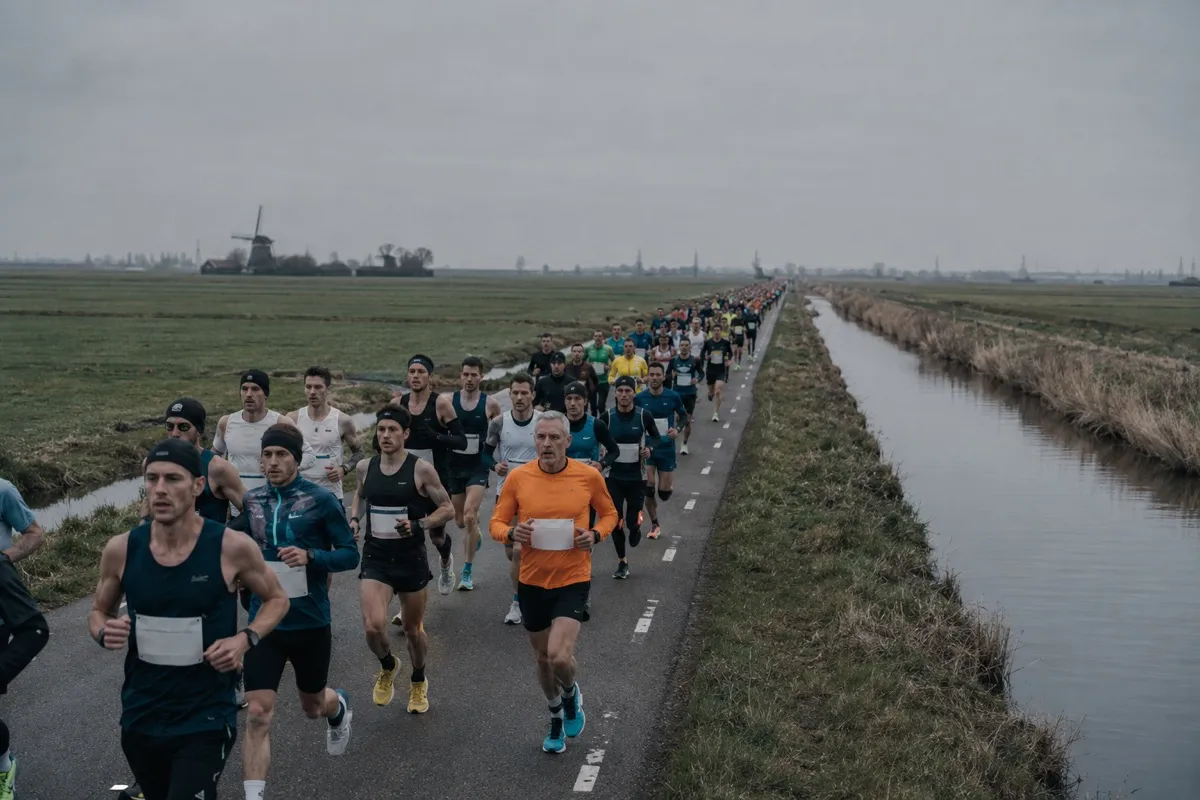
The Netherlands is, by population, the second most prolific racing nation on earth, behind only Ireland (RunRepeat). And the Dutch race distances most of the world ignores. I should know. I race here, and my own PR list is full of numbers that confuse foreign calculators.
The Dam tot Damloop, Amsterdam to Zaandam, is 10 English Miles. Not a half, not a 15K, not a 10 mile rounded to the nearest kilometre. Exactly 16.09 km. It draws more than 50,000 runners every September and has since the mid-1980s (Wikipedia). The Zevenheuvelenloop in Nijmegen is a 15K, a distance that exists partly because in 1984 the national federation refused to sanction new races longer than 12 km. The organisers got as close to the limit as they could. It is now one of the fastest 15K courses anywhere. Jacob Kiplimo set a world best there in 2024 (Wikipedia).
My own best age grade is one of those odd distances. 57:08 for 10 English Miles at Leusden, aged 46, which grades 82.5% and beats every marathon I have run. Quote that time to a runner outside the Netherlands and it lands nowhere. Quote the percentage and it lands everywhere.
A 50-year-old running a strong 10 EM has very few international rivals to compare against. That is precisely why age-graded percentages matter more here than almost anywhere. The raw time means little abroad. The percentage travels. It is also why two calculators can hand you different numbers for the same race: the odd distances are the ones editions disagree about most.
Asia-Pacific is where the sport is still growing

Most regions are flat or shrinking in participation. Asia-Pacific is the exception, with race numbers climbing through the 2020s (RunRepeat, The State of Running 2019), and Japan's running culture skews notably older than any other major racing nation. That last fact is the one masters runners should sit with.
Japan's defining contribution is not a single race. It is a format: the ekiden, the road relay. Teams of six share a marathon distance, passing a tasuki sash instead of a baton. The Hakone Ekiden, run every January 2nd and 3rd, pulls 65 million TV viewers, which is Super Bowl territory (Maurten). The first ekiden was held in 1917, decades before recreational marathons existed in most of the world (Wikipedia).
The Japanese model is instructive. The country produces some of the world's fastest 50+ marathoners, as the NYC data confirms, and does so in a culture where serious training deep into your sixties is the default rather than the exception. It is also where the highest age-graded marathons ever run keep coming from.
Why do masters runners peak at the longest distances?
Past a certain distance the age curve flips. In ultramarathons over 200 km, the fastest finishers are typically 40–45 years old (analysis of 200 km+ ultras). Masters runners do not merely hold their own there. They win outright. The endurance demands reward accumulated training years, and those take a long time to bank.
South Africa is where this plays out at scale. The Comrades Marathon, 87 km between Pietermaritzburg and Durban and reversing direction each year, is the world's oldest and largest ultra, run annually since 1921 (Wikipedia). The Two Oceans, 56 km around the Cape Peninsula, started as Comrades training in 1970 and now draws around 14,000 entries of its own (Wikipedia). South Africa has built a culture of ultra running unmatched anywhere in the world. Comrades draws a field where even mid-pack times would win national ultras elsewhere.
The reasons are partly historical. Sporting isolation under apartheid made domestic events disproportionately important, and Comrades grew into a national rite of passage. But the masters skew is structural too. Ultra running rewards patience and base-building, and both take years a 25-year-old simply has not lived yet.
What does this mean for your race results?
Where you race shapes what you race, and no two PR lists from two countries look alike. A Dutch runner's distances are not an American's, which are not a Japanese runner's. The fields differ. So does the cultural meaning of finishing at all.
Age grading strips that away. It asks one question. Measured against the world best for your age and sex, how fast did you actually run? An 80% 10 EM in Zaandam, an 80% marathon in Tokyo and an 80% turkey trot in Boston all sit the same distance below their own event's ceiling. That is what makes them comparable at all.
It does not make them equally easy to reach. The same runner usually scores several points higher at 5K than at the marathon, because the tables are built differently by distance. The scale travels. Your own result on it still moves with the event.
The regional traditions are wonderful and worth keeping. But they are increasingly the surface of the sport rather than its substance. Underneath, the global masters community is doing something the demographic data never predicted a generation ago. Getting older, staying serious, and quietly setting standards no one expected of them.
Either way, the clock in Buffalo and the clock in Nijmegen measure the same thing. Only the percentage knows what it cost you.
Sources
- Athletes' origin trends in the New York City Marathon, 1999–2024 — retrieved 2026-05-24, https://pmc.ncbi.nlm.nih.gov/articles/PMC12877032/
- RunRepeat / IAAF, The State of Running 2019 — retrieved 2026-05-24, https://runrepeat.com/state-of-running
- Knechtle et al., half-marathon and marathon participation in Switzerland 1999–2014 — retrieved 2026-05-24, https://pmc.ncbi.nlm.nih.gov/articles/PMC4726642
- MDPI IJERPH, "The Impact of Training on the Loss of Cardiorespiratory Fitness in Aging Masters Endurance Athletes," 2022 — retrieved 2026-06-17, https://www.mdpi.com/1660-4601/19/17/11050
- LiveStrong, Essential Running Statistics (citing IIRM) — retrieved 2026-05-24, https://www.livestrong.com/article/13730338-running-statistics/
- Six Minute Mile, Turkey Trot tradition (citing RunSignup 2024) — retrieved 2026-05-24, https://sixminutemile.com/post/turkey-trot-run-american-thanksgiving-tradition/
- Turkey trot (running) — retrieved 2026-05-25, https://en.wikipedia.org/wiki/Turkey_trot_(running)
- SGB Media, 2024 Global Runner Survey — retrieved 2026-05-24, https://sgbonline.com/global-survey-running-participation-surpasses-pre-pandemic-levels/
- Great North Run — retrieved 2026-05-24, https://en.wikipedia.org/wiki/Great_North_Run
- Marathons.com, San Silvestre Vallecana 2025 — retrieved 2026-05-24, https://www.marathons.com/en/news/san-silvestre-vallecana-2025-madrid-celebrates-with-42000-runners/
- Dam tot Damloop — retrieved 2026-05-24, https://en.wikipedia.org/wiki/Dam_tot_Damloop
- Zevenheuvelenloop — retrieved 2026-05-24, https://en.wikipedia.org/wiki/Zevenheuvelenloop
- Maurten, The ekiden — retrieved 2026-05-24, https://www.maurten.com/magazine/the-ekiden
- Ekiden — retrieved 2026-05-24, https://en.wikipedia.org/wiki/Ekiden
- Analysis of ultramarathons over 200 km — retrieved 2026-05-24, https://pmc.ncbi.nlm.nih.gov/articles/PMC3625029/
- Comrades Marathon — retrieved 2026-05-25, https://en.wikipedia.org/wiki/Comrades_Marathon
- Two Oceans Marathon — retrieved 2026-05-24, https://en.wikipedia.org/wiki/Two_Oceans_Marathon