
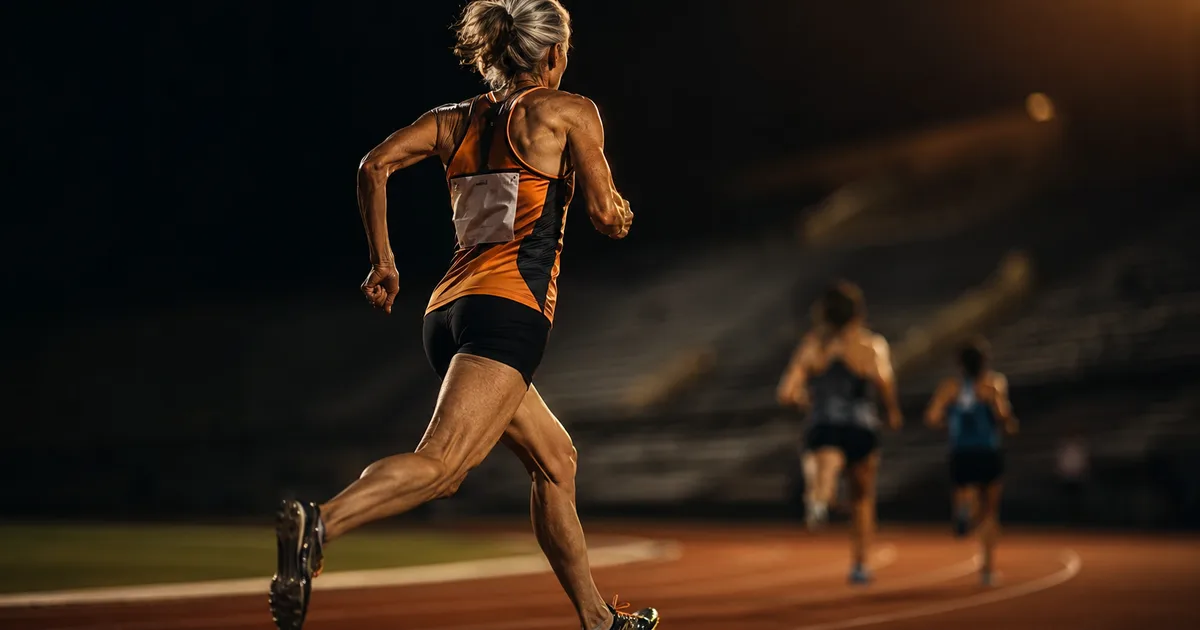
Clare Elms, number 62 on her back, lined up at the Hercules Wimbledon 1500m PB meeting on May 27, 2026. Eight of her ten opponents were young enough to be her grandchildren. Into a 20 mph easterly, she ran 4:56.77.
New W60 world record, set at 62. She'd held the previous mark herself, 4:56.85, in 2025.
Graded at her exact age on the WMA 2023 tables, that 4:56.77 scores 98.9%. Remarkable, clearly. But technically not 100%. The model says there's still room.
That gap, between the world record and the ceiling the tables project, is worth understanding. Because the same spring, over two road races, she ran past that ceiling entirely. The world record, in the strictest age-grading sense, was her weakest number of the three.
Why isn't a world record automatically 100% in age grading?
So here's the thing about the WMA age-grading tables that most runners assume but never verify: they are not a record lookup.
The tables are a mathematical curve. They're fitted across the full arc of human performance, from open elite athletes in their mid-twenties through to the oldest masters ages. For each age, sex, and event combination, the curve produces a projected standard. The theoretical outer edge of what's physiologically achievable.
The key word is theoretical. The model can produce a 1500m standard of about 4:53.6 for a 62-year-old woman even though no one has run that time. No record exists to match it. The model computed it from the shape of the curve, from elite performance across ages and distances, and from what's known about how ageing affects the physiological systems that govern speed.
This is what makes the situation with world records interesting. A world record is the outer limit of what humans have actually done. The WMA model looks at the full decay curve and calculates what a 62-year-old woman is physiologically capable of. Those two things don't have to agree.
Elms's 4:56.77 is the fastest any 62-year-old woman has run 1500 metres. And yet the WMA model says 4:53.6 is achievable, about 3 seconds faster. At 98.9%, she's 1.1 points below that ceiling.
She's said better conditions and a cleaner race would help. The model, for once, agrees with her.
This is different from the common shorthand. "100% is the world record standard" is almost right. It isn't quite. 100% is the model's best estimate of what's possible. The record is what's been done. They're often close. They're not the same thing.
See what age-graded percentage actually means for the formula and tier breakdowns.
The three performances, age graded
The 1500m world record got the headlines. It's the weakest number in her spring portfolio.
| Performance | Event | Age | Table | AG% |
|---|---|---|---|---|
| 4:56.77 | 1500m (track) | 62 | WMA 2023 | 98.9% |
| 17:45 | 5km (road) | 62 | Alan Jones 2025 | 105.4% |
| 29:53 | 5 miles (road) | 62 | Alan Jones 2025, interpolated | about 102%* |
*No table publishes a 5-mile standard directly. It has to be interpolated between the published 5K and 10K factors, which carries more uncertainty than the track figure. Treat that one as approximate. The direction isn't in doubt.
Two of the three sit above the ceiling. The 5km, run in Battersea in April 2026, is the rarer achievement by the tables' own measure. It beats what a curve fitted to decades of masters performance projected was achievable at this age. Athletics Weekly reported the Battersea 5km world best, and every road table I ran it through agrees on the direction.
The asymmetry is worth sitting with. On the track, into a 20 mph headwind and without a clean run, she fell 3 seconds short of a theoretical model. On the roads that spring she ran clean, and came out the other side of the ceiling on both distances. The 1500m world record is the underperformer of the three, by the tables' own arithmetic.
A progression that defies the curve
The WMA model encodes an ageing assumption. For each event, the curve estimates how performance typically declines from the open-elite peak onward. The general direction is downward. That's not pessimism. It's physiology.
Elms's 1500m trajectory since turning 56 doesn't look like that.
| Year | Age | 1500m best |
|---|---|---|
| 2020 | 56 | 4:58.23 |
| 2021 | 57 | 4:58.45 |
| 2022 | 58 | 4:58.34 |
| 2023 | 59 | 4:57.10 |
| 2024 | 60 | 4:57.14 |
| 2025 | 61 | 4:56.85 |
| 2026 | 62 | 4:56.77 |
Seven years. About 1.5 seconds of improvement, not decline.
But the age-grade story is more interesting than the raw clock. Her 4:58.23 at 56 graded 93.1%. The same shape of run at 62 grades 98.9%, because the age standard eases every year and her clock didn't. The benchmark moved. She stayed ahead of it.
That's 5.8 points of age grade for about 1.5 seconds of clock. It's the same arithmetic I watch on my own results, in the other direction: the tables hand back time every year, and the score only moves if you beat what they handed back. She has, seven years running.
The tables are built for population averages. She's not at the average. She's at the far tail of what the ageing curve expects. Which is precisely why the question of whether she can close the remaining 3 seconds on the 1500m isn't aspirational. It's legitimate.
See why your marathon age grade differs from your 5K for the same mechanism at other events.
What does above 100% actually mean?
A score above 100% has a specific technical meaning: the performance exceeded the WMA model's projected world-class standard for that age, sex, and distance.
It happens rarely, and it happens on the short stuff. Over the marathon it barely happens at all. Even the ten greatest masters marathons ever age-graded top out at 99.15%, because the distance refuses to discount a slow time. When a score does clear 100%, one of two things is going on. Either the model underestimated what's achievable at that age, which is plausible in age groups with thin historical data where the fitted curve is less stable, or the athlete ran into territory the model genuinely didn't anticipate.
For road distances at this age, the tables use factors derived from a broad dataset. The projection isn't fragile. An athlete exceeding it doesn't expose a data artefact. It's more likely the second thing.
Why don't the record book and the tables agree?
Because they update on different clocks. The record books change the moment a mark falls. The tables change on a revision cycle: 2015, 2023, and whatever comes next. So an athlete can run past the current model's ceiling and the tables won't reflect it until the next revision. In the meantime the score reads above 100%, the record shows the new time, and the two systems agree on exactly one thing. This was not supposed to be possible yet.
She wasn't the only one that month. Andrew Ridley ran 2:06.67 for 800m at Winchester on 20 May 2026, an M60 world record, and his indoor mark of 2:05.13 suggests the outdoor one sits close to the model's ceiling too. Christine Harrison-Bloomfield's W55 European sprint records from Stratford, 12.67 for 100m and 26.26 for 200m, say the same thing about where the tables sit against the current outer edge of the sport (Athletics Weekly, "Clare Elms, 62, runs sub-5min for 1500m", retrieved 2026-05-28).
The gap as information
At the end of all this, 98.9% is not a disappointment. It's information.
It says: there are 3 seconds between the fastest any 62-year-old has run 1500 metres and what a modelled curve, fitted to decades of masters performance, calculates is achievable. That model has a track record of being more right than wrong. It isn't infallible. But the gap it's pointing at isn't noise.
The 5km and 5-mile marks are on the other side of the same line. Those say the model itself may need updating.
Two kinds of evidence. One athlete. One remarkable spring.
The methodology page explains which table version applies to your results. Or run any finish time through the calculator and see the number yourself.
Sources
Every percentage in this post was computed with the RaceRecords engine, at her exact age on the day: WMA 2023 for the track 1500m (open standard 3:49.04) and Alan Jones 2025 for the road results. The 5-mile figure interpolates between the published 5K and 10K factors and is approximate.
- Athletics Weekly, "Clare Elms, 62, runs sub-5min for 1500m" — the 4:56.77 W60 record at Hercules Wimbledon, plus Andrew Ridley's M60 800m and Christine Harrison-Bloomfield's W55 sprint marks, May 2026. Retrieved 2026-05-28. https://athleticsweekly.com/news/clare-elms-62-runs-sub-5min-for-1500m-1040011328/
- Athletics Weekly, "Clare Elms improves world W60 5km best in Battersea" — the 17:45 road 5km, April 2026. Retrieved 2026-05-28. https://athleticsweekly.com/news/clare-elms-improves-world-w60-5km-best-in-battersea-1040011454/
- World Masters Athletics, WMA 2023 age-grading standards — the track factors behind the 1500m percentages. Retrieved 2026-05-28. https://world-masters-athletics.org
- Alan Jones, Age-Grade Tables, 2025 road edition — the road factors RaceRecords applies to the 5km and 5-mile results. Retrieved 2026-05-28. https://github.com/AlanLyttonJones/Age-Grade-Tables