
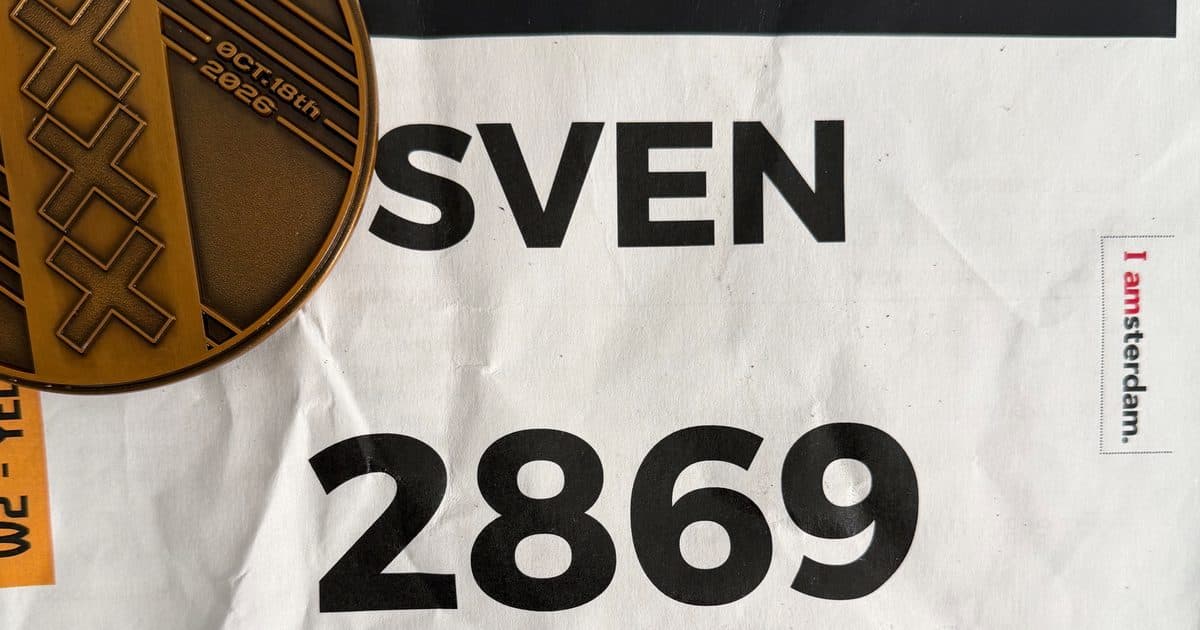
2:44:51 in Amsterdam. Age-graded at 80.14%. My London marathon from 2024 scored 80.15%.
So I missed a marathon age-grade PR by one second. Possibly because of a rounding on the official clock. And my own website had spent three months telling me 2:44:51 was the time to beat, which was a second too slow.
Normally I write age grades to one decimal. At one decimal, both races are 80.1%. That is the whole post, really. But the second decimal is where this one was decided, so I will use two, and three where the arithmetic needs it.
How did the Amsterdam Marathon go?
Better than I expected. I ran 2:44:51 with a negative split, 1:22:50 for the first half and 1:22:01 for the second. That was 519th overall and 27th of 1,657 in M45. On the start line I did not think sub 2:45 was on.
So I started cautiously. It was raining at the start, and in some parts of the course it was properly windy. My plan was simple. Keep the heart rate under control, and only speed up if it stayed there.
It did. The official splits tell the story better than I can.
| Split | Segment | Total | Pace | Avg HR |
|---|---|---|---|---|
| 5 km | 20:01 | 20:01 | 4:00/km | 149 |
| 10 km | 19:35 | 39:36 | 3:55/km | 154 |
| 15 km | 19:29 | 59:05 | 3:54/km | 155 |
| 20 km | 19:28 | 1:18:33 | 3:54/km | 154 |
| 25 km | 19:26 | 1:37:59 | 3:53/km | 157 |
| 30 km | 19:22 | 1:57:21 | 3:52/km | 160 |
| 35 km | 19:25 | 2:16:46 | 3:53/km | 162 |
| 40 km | 19:31 | 2:36:17 | 3:54/km | 165 |
| Finish | 8:34 | 2:44:51 | 3:54/km | 168 |
Splits and times are the official chip splits. The heart rate comes from my watch laps, which line up with these 5 km segments to within a few seconds.
The whole race I was doing sums. Current pace, distance left, projected finish. Over and over, the way you do when your brain needs something to chew on. After 25 km I pushed a little more, to see if I could get closer to 2:45. The heart rate went up with it, 160 and then 162, but it stayed manageable.
The last 2 km
It was only at 40 km that I remembered the age-grade target. I had written a whole blog post about it. I knew it was somewhere around 2:44 and a bit. But my legs were hurting, and I could not remember the exact number. So for the last two kilometres I only had one thing in my head, sub 2:45.
In the final 200 metres I sprinted. My heart rate hit 174, the highest of the day. I stopped my watch on the finish line at 2:44:50. I was happy.
Why was 2:44:51 not an age-grade PR?
Because the break-even at 48 is 2:44:50.58, and 2:44:51 is slower than that.
So the arithmetic. Age grade is the open-class standard divided by your time times the age factor. On the Alan Jones 2025 tables the marathon standard is 2:00:35 (7235 seconds), Kiptum's world record. The factor at 48 is 0.9127, so for me that is 7235 ÷ (time × 0.9127). At London I was 46, with a factor of 0.9291.
| Race | Age | Factor | Time | AG% |
|---|---|---|---|---|
| London 2024 | 46 | 0.9291 | 2:41:56 | 80.147% |
| Break-even at 48 | 48 | 0.9127 | 2:44:50.58 | 80.147% |
| My watch | 48 | 0.9127 | 2:44:50 | 80.152% |
| Amsterdam official | 48 | 0.9127 | 2:44:51 | 80.144% |
London is really 80.147%, which displays as 80.15%. Amsterdam is 80.144%, which displays as 80.14%. The real gap is three thousandths of a point. But a record is a record, and an age-grade PR has to be higher, not equal.
Why did my own website round the target up?
Because the RaceRecords PR card rounded the target to the nearest second. It showed 2:44:51 as my marathon target to beat. That number was wrong.
So I went looking. The site calculates the exact break-even correctly, 2:44:50.58. But the card then rounded it to the nearest second for display. Anything with .5 or more after the second gets rounded up, which makes the target slower than the real break-even. That happens to roughly half of all targets.
The annoying part is that I had already solved this once. The Targets to Beat page rounds the required time down, on purpose, and my marathon row there said 2:44:50 all along. The PR card and the dashboard hero used a different formatter that rounded to nearest. Two pages, same calculation, one second apart.
There was a second, smaller flaw. Even rounded down, a target that lands on an exact whole second only ties the record. A tie is not a PR. So every "to beat" target on RaceRecords now shows the largest whole second strictly faster than break-even. For my marathon at 48 that is 2:44:50, which grades 80.152%.
Did the official clock round up too?
Probably, but I cannot prove it. I stopped my watch on the line at 2:44:50. The official chip time says 2:44:51.
I do not know the exact reason. The timing data only goes to whole seconds. It literally reads 02:44:51.000. So a chip time of 2:44:50.6 would show up as 2:44:51.
It is also possible I hit stop a stride before the timing mat. Either way, the official time is the one that counts, and I would not want it any other way. A watch time is not a race result.
(For the record, my gun time was 2:45:06. So sub 2:45 only on the chip.)
So two roundings, both in the wrong direction. The clock probably rounded my time up. The site had been a second too generous with my target for three months. Would I have found one more second in that sprint if I had known the real number? Maybe. I was racing for sub 2:45 by then anyway. I will never know.
Back to my old form anyway
The PR is the footnote. The time is the story.
In March I ran 2:50:05 at Two Rivers, my best marathon since the knee surgery, at 77.68%. Seven months later I ran 5:14 faster. Negative split, rain and wind, heart rate under control until the last 2 km. After a year where I could barely run 45 minutes without pain, that matters more to me than three thousandths of a point.
| Race | Date | Time | Age | AG% |
|---|---|---|---|---|
| London | 21 Apr 2024 | 2:41:56 | 46 | 80.15% |
| NYC | 2 Nov 2025 | 2:56:19 | 48 | 74.93% |
| Two Rivers | 15 Mar 2026 | 2:50:05 | 48 | 77.68% |
| Amsterdam | 18 Oct 2026 | 2:44:51 | 48 | 80.14% |
Still, the record stands, and the target moves. I turn 49 soon. At 49 the marathon factor eases again, and the time to beat London's 80.147% becomes 2:46:20. Same record, more room. The tables, as ever, are on my side.
Either way, I will take the 2:44:51.
Sources
- Alan Jones, Age-Grade Tables (road, 2025 edition) — retrieved 2026-10-19
- World Athletics, "Ratified: world marathon record for Kelvin Kiptum" (2:00:35, the open-class marathon standard in the 2025 tables) — retrieved 2026-10-19
- Amsterdam Marathon 2026, official result and splits for bib 2869 (Sporthive / MYLAPS) — retrieved 2026-10-19
- Watch laps and heart rate: my own watch data, synced to Strava
- RaceRecords, Methodology — retrieved 2026-10-19